
Referring to Positive Behaviour Support: What Support Coordinators Need to Know
As a Support Coordinator or allied health professional working with NDIS participants, the quality of your PBS referrals directly affects participant outcomes.
Understanding what good PBS looks like and how to match participants to the right level of support is one of the most valuable skills you can develop in your role.

PBS Under the NDIS: Funding and Registration
Behaviour support falls under Capacity Building: Improved Relationships (CB Relationships) in an NDIS plan. For participants where any regulated restrictive practice is in use (or where there is a risk they may be introduced), a registered behaviour support provider is not optional; it's a legislative requirement under the NDIS (Restrictive Practices and Behaviour Support) Rules 2018.
Key registration considerations for referrers:
- Only NDIS-registered behaviour support providers can develop behaviour support plans that authorise regulated restrictive practices.
- Registered providers must report the use of restrictive practices to the NDIS Commission.
- Interim behaviour support plans must be developed within agreed timeframes; comprehensive plans require functional behaviour assessment before completion.
- Sigma Therapies is a registered NDIS provider for behaviour support.
If you're unsure whether a participant's current arrangements require a registered provider, the NDIS Commission's provider registration guidelines are the definitive reference.
The Seven Capability Domains:
What Your Referral Should Cover
The NDIS PBS Capability Framework organises practitioner competencies across seven domains. A well-structured referral and PBS response should address all of them:
- Interim Response: Immediate safety strategies while a comprehensive assessment is underway.
- Functional Behaviour Assessment: Identification of antecedents, setting events, functions of behaviour, and environmental factors.
- Behaviour Support Planning: Collaborative, rights-based plan development with participant and support network.
- Implementation: Coaching and capacity building for carers, support workers, and educators.
- Know It Works: Data collection, monitoring, and plan review cycles.
- Reduce and Eliminate Restrictive Practices: Authorisation processes, reporting, and active reduction strategies.
- Continuing Professional Development and Supervision: Practitioner currency and quality assurance.
When reviewing a PBS provider's offering, these domains provide a useful audit framework. A provider who can articulate their approach across all seven (not just assessment and plan writing) is demonstrating genuine capability.
What Makes a High-Quality Referral
Incomplete referrals create delays and, more significantly, mean the practitioner begins work without the context needed to develop an effective plan. When referring to Sigma Therapies for PBS, the most useful information includes:
Clinical and background information:
- Current diagnoses and relevant medical history
- Previous behaviour support plans (if any)
- Functional communication level and preferred communication methods
- Known sensory, trauma, or anxiety considerations
Current behaviour context:
- Description of behaviours of concern (topography, frequency, intensity, duration, where known)
- Settings where behaviours occur (home, school, community, transport)
- Current restrictive practices in use, if any, and whether NDIS Commission notification has occurred
- Any existing safety or crisis plans
Support network:
- Names and roles of key people in the participant's life (family, support workers, educators)
- Any existing allied health team: Occupational Therapy, speech pathology, psychology
- Support coordinator contact details for ongoing coordination
NDIS plan details:
- Funding available under CB Relationships
- Plan managed or agency managed
- Plan review date
The more complete this picture, the faster we can mobilise, and the more targeted the initial assessment will be.
PBS and Restrictive Practice Compliance:
What Referrers Need to Know
This is the area where referrers sometimes feel uncertain — and it matters significantly.
If a participant is currently subject to any regulated restrictive practice (physical restraint, chemical restraint, mechanical restraint, seclusion, or environmental restraint), the following apply:
- A registered behaviour support provider must be engaged.
- The restrictive practice must be authorised in accordance with state/territory requirements (in WA, this is governed through the Disability Services Act and NDIS Commission requirements).
- The behaviour support plan must include active strategies to reduce and, where clinically appropriate, eliminate the restrictive practice over time.
- The provider must report regulated restrictive practice use to the NDIS Commission.
Non-compliance in this area carries significant consequences for both the service provider delivering the restrictive practice and, increasingly, for other parties in the participant's support network who have awareness of the situation.
If you have a participant in this situation and are unsure about the next steps, contact our team. We're experienced in navigating these compliance requirements and can advise on appropriate referral pathways.
Sigma Therapies: Referral Pathway
Referring to Sigma Therapies for PBS is straightforward:
- Step 1: Complete our referral form or contact our intake coordinator directly
- Step 2: We'll review the referral and confirm the right practitioner level for the participant's needs
- Step 3: Intake call with the participant and/or their support network
- Step 4: Interim plan developed within agreed timeframes if required
- Step 5: Functional behaviour assessment and comprehensive plan development
- Step 6: Ongoing implementation support, coaching, and review cycles
Current wait times: Our intake process is done under 48 hours, with appointments usually secured within two weeks. We recommend you contact us for current availability as we maintain a priority pathway for participants with urgent restrictive practice compliance needs.
Accepted funding: NDIS self-managed, plan-managed and agency-managed.
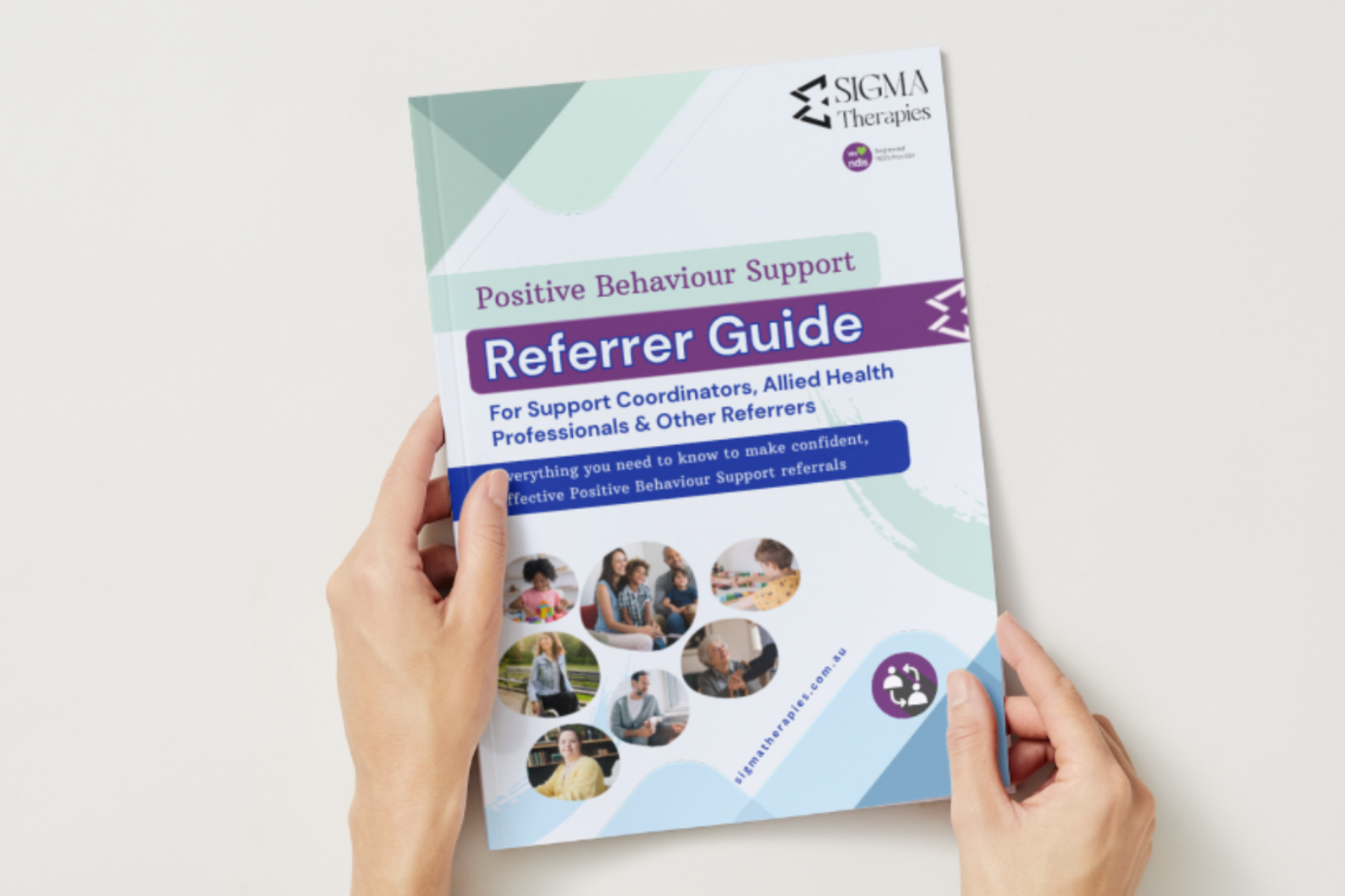
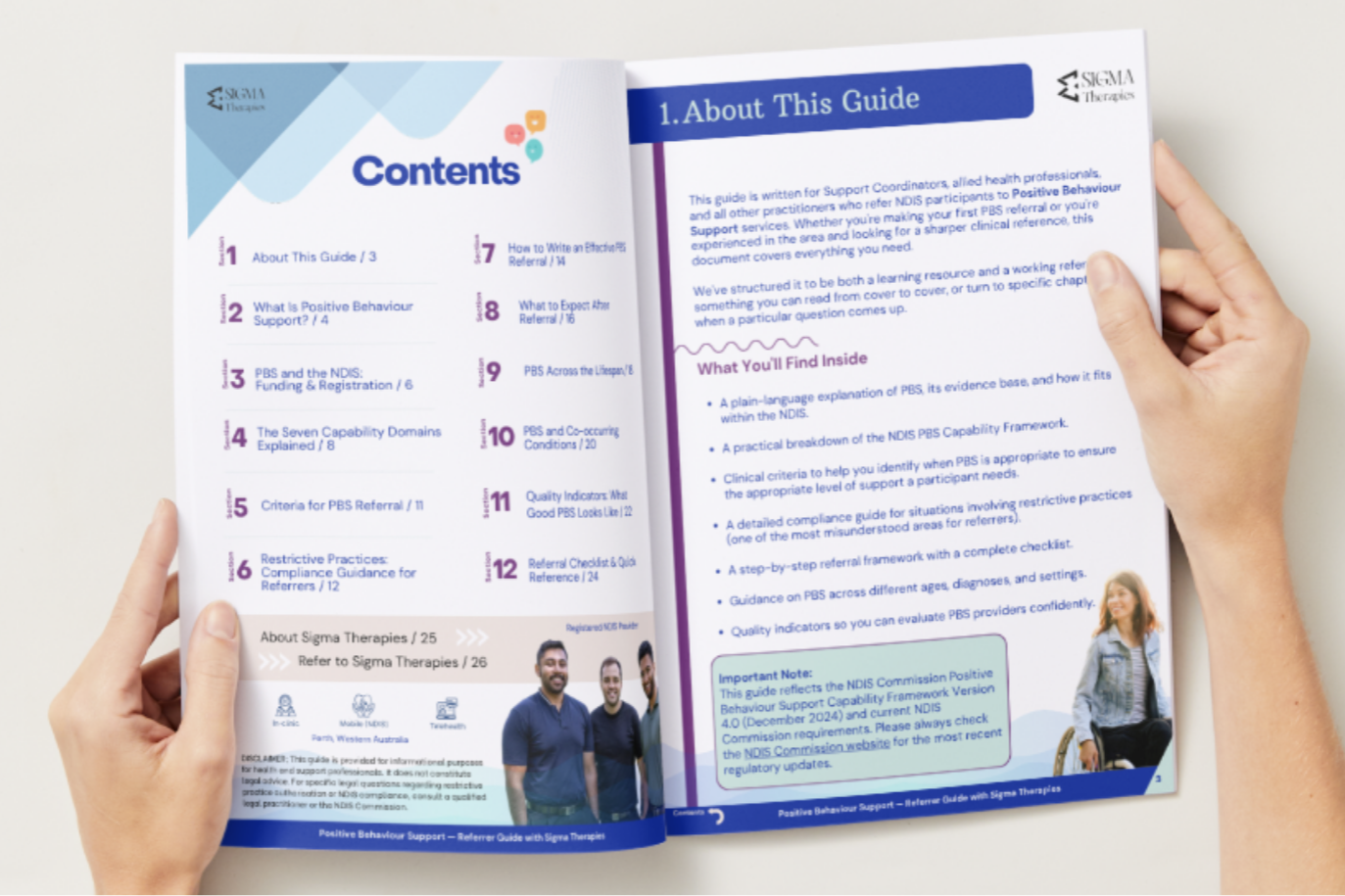
Your Free Guide to Making Confident Positive Behaviour Support Referrals
Get In Touch
For referral enquiries, clinical consultations, or questions about complex cases, our team welcomes conversations with support coordinators and allied health professionals.
Other blog posts you may be interested in: